3/30/2026 - Week 12 / Meeting 19: Positive Psychology / Hero's Journey
HOOK
The 20 best things you can say to a person in distress
Supportive language prioritizes validation, respect, and presence rather than minimizing, fixing, or forcing someone into a specific healing path.
1. "I believe you." Validates their experience and counters disbelief.'
2. "What happened to you was not your fault." Removes blame and affirms their innocence.
3. "You didn't deserve what happened to you." Counters shame and self-blame.
4. "Your feelings make sense." Acknowledge their emotional reality without judgement.
5. "You are not alone in this." Reminds them of support and connection.
6. "I'm here for you, no matter how long it takes." Affirms that healing ins;t on a timeline.
7. "You don't have to talk about it if you don't want to, but I am here if your do." Respects their autonomy while offering support.
8."Your survival is proof of your strength, but you shouldn't have had to be this strong." Recognizes resilience without glorifying suffering.
9. "It makes sense that this is hard. It's not just in your head - your body and nervous system went through real harm." Acknowledges the psychological impact of trauma.
10. "You deserve care, support, and safety." Affirms their right to well-being.
11. "If you are feeling overwhelmed, I can just sit with you. You don't have to go through this alone." Offers presence without pressure.
12. "You reactions make sense given what you've been through." Normalizes trauma responses.
13. "You have nothing to prove. Your worth isn't tied to what happened to you or how your respond to it." Counters internalized pressure to "perform" healing.
14. "You don't need to be 'better' to be worthy of love and respect." Reinforces unconditional support.
15. "You are allowed to feel angry/sad/frustrated/hurt. I won't tell you to 'move on' or 'let go." gives permission to process emotions.
16. "Healing isn't linear, and there's no right or wrong way to do it." Removes unrealistic expectations.
17. "You are not broken. Your nervous system is doing what it learned to do to protect you." Reframes trauma responses as adaptations, not flaws.
18. "I won't try to fix this, but I will stand beside you as you navigate it." Avoids toxic positivity while offering solidarity.
19. "It's okay if today is just about surviving . That is enough." Relieves pressure to "achieve" recovery.
20. "I see you, I hear you, and I care about you." Offers the fundamental human need for connection and recognition.
- Understand the Hero's Journey
- Explain the different stages of the Hero's Journey
- Gain an awareness of the importance of one's own journey
- Experience the creation of one's own individual journey

Three Pillars of Positive Psychology
Positive Psychology has three central concerns: positive experiences, positive individual traits, and positive institutions.
- Understanding positive emotions entails the study of contentment with the past, happiness in the present, and hope for the future.
- Understanding positive individual traits involves the study of strengths, such as the capacity for love and work, courage, compassion, resilience, creativity, curiosity, integrity, self-knowledge, moderation, self-control, and wisdom.
- Understanding positive institutions entails the study of the strengths that foster better communities, such as justice, responsibility, civility, parenting, nurturance, work ethic, leadership, teamwork, purpose, and tolerance.
- Positive Emotions:
- Engagement
- Meaning
- Relationships
- Accomplishment
Together these areas encapsulate two aspects of individual wellbeing:
- Subjective wellbeing (SWB)—hedonic experience, happiness, satisfaction and positive emotions in the moment
- Psychological wellbeing (PWB)—eudaimonic experience, the more enduring sense of fulfillment we get from personal relationships, living a meaningful life and developing as a person.
Hero's Journey
In narratology and comparative mythology, the hero's journey, also known as the monomyth, is the common template of stories that involve a hero who goes on an adventure, is victorious in a decisive crisis, and comes home changed or transformed.
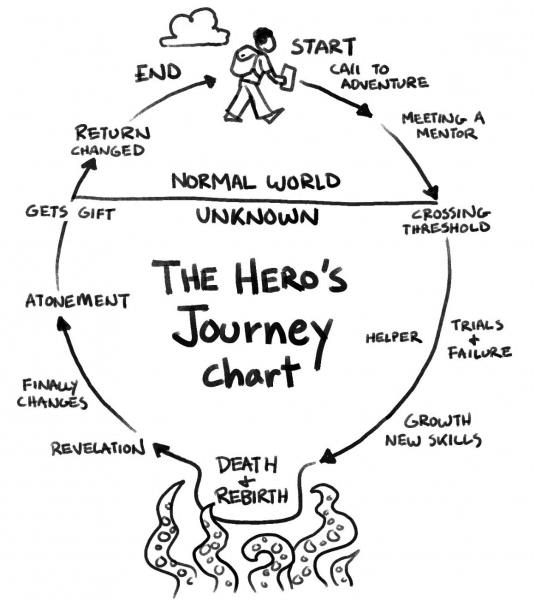
1. Ordinary World
This is where the Hero's exists before his present story begins, oblivious of the adventures to come. It's his safe place. His everyday life where we learn crucial details about our Hero, his true nature, capabilities and outlook on life. This anchors the Hero as a human, just like you and me, and makes it easier for us to identify with him and hence later, empathize with his plight.
2. Call To Adventure
The Hero's adventure begins when he receives a call to action, such as a direct threat to his safety, his family, his way of life or to the peace of the community in which he lives. It may not be as dramatic as a gunshot, but simply a phone call or conversation but whatever the call is, and however it manifests itself, it ultimately disrupts the comfort of the Hero's Ordinary World and presents a challenge or quest that must be undertaken.
3. Refusal Of The Call
Although the Hero may be eager to accept the quest, at this stage he will have fears that need overcoming. Second thoughts or even deep personal doubts as to whether or not he is up to the challenge. When this happens, the Hero will refuse the call and as a result may suffer somehow. The problem he faces may seem to much to handle and the comfort of home far more attractive than the perilous road ahead. This would also be our own response and once again helps us bond further with the reluctant Hero.
4. Meeting The Mentor
At this crucial turning point where the Hero desperately needs guidance he meets a mentor figure who gives him something he needs. He could be given an object of great importance, insight into the dilemma he faces, wise advice, practical training or even self-confidence. Whatever the mentor provides the Hero with it serves to dispel his doubts and fears and give him the strength and courage to begin his quest.
5. Crossing The Threshold
The Hero is now ready to act upon his call to adventure and truly begin his quest, whether it be physical, spiritual or emotional. He may go willingly or he may be pushed, but either way he finally crosses the threshold between the world he is familiar with and that which he is not. It may be leaving home for the first time in his life or just doing something he has always been scared to do. However the threshold presents itself, this action signifies the Hero's commitment to his journey an whatever it may have in store for him.
6. Tests, Allies, Enemies
Now finally out of his comfort zone the Hero is confronted with an
ever more difficult series of challenges that test him in a variety of
ways. Obstacles are thrown across his path; whether they be physical
hurdles or people bent on thwarting his progress, the Hero must overcome
each challenge he is presented with on the journey towards his ultimate
goal.
The Hero needs to find out who can be trusted and who can't. He may earn
allies and meet enemies who will, each in their own way, help prepare
him for the greater ordeals yet to come. This is the stage where his
skills and/or powers are tested and every obstacle that he faces helps
us gain a deeper insight into his character and ultimately identify with
him even more.
7. Approach To The Inmost Cave
The inmost cave may represent many things in the Hero's story such as
an actual location in which lies a terrible danger or an inner conflict
which up until now the Hero has not had to face. As the Hero approaches
the cave he must make final preparations before taking that final leap
into the great unknown.
At the threshold to the inmost cave the Hero may once again face some of
the doubts and fears that first surfaced upon his call to adventure. He
may need some time to reflect upon his journey and the treacherous road
ahead in order to find the courage to continue. This brief respite
helps the audience understand the magnitude of the ordeal that awaits
the Hero and escalates the tension in anticipation of his ultimate test.
8. Ordeal
The Supreme Ordeal may be a dangerous physical test or a deep inner
crisis that the Hero must face in order to survive or for the world in
which the Hero lives to continue to exist. Whether it be facing his
greatest fear or most deadly foe, the Hero must draw upon all of his
skills and his experiences gathered upon the path to the inmost cave in
order to overcome his most difficulty challenge.
Only through some form of "death" can the Hero be reborn, experiencing a
metaphorical resurrection that somehow grants him greater power or
insight necessary in order to fulfill his destiny or reach his journey's
end. This is the high-point of the Hero's story and where everything he
holds dear is put on the line. If he fails, he will either die or life
as he knows it will never be the same again.
9. Reward (Seizing The Sword)
After defeating the enemy, surviving death and finally overcoming his
greatest personal challenge, the Hero is ultimately transformed into a
new state, emerging from battle as a stronger person and often with a
prize.
The Reward may come in many forms: an object of great importance or
power, a secret, greater knowledge or insight, or even reconciliation
with a loved one or ally. Whatever the treasure, which may well
facilitate his return to the Ordinary World, the Hero must quickly put
celebrations aside and prepare for the last leg of his journey.
10. The Road Back
This stage in the Hero's journey represents a reverse echo of the
Call to Adventure in which the Hero had to cross the first threshold.
Now he must return home with his reward but this time the anticipation
of danger is replaced with that of acclaim and perhaps vindication,
absolution or even exoneration.
But the Hero's journey is not yet over and he may still need one last
push back into the Ordinary World. The moment before the Hero finally
commits to the last stage of his journey may be a moment in which he
must choose between his own personal objective and that of a Higher
Cause.
11. Resurrection
This is the climax in which the Hero must have his final and most
dangerous encounter with death. The final battle also represents
something far greater than the Hero's own existence with its outcome
having far-reaching consequences to his Ordinary World and the lives of
those he left behind.
If he fails, others will suffer and this not only places more weight
upon his shoulders but in a movie, grips the audience so that they too
feel part of the conflict and share the Hero's hopes, fears and
trepidation. Ultimately the Hero will succeed, destroy his enemy and
emerge from battle cleansed and reborn.
12. Return With The Elixir
This is the final stage of the Hero's journey in which he returns
home to his Ordinary World a changed man. He will have grown as a
person, learned many things, faced many terrible dangers and even death
but now looks forward to the start of a new life. His return may bring
fresh hope to those he left behind, a direct solution to their problems
or perhaps a new perspective for everyone to consider.
The final reward that he obtains may be literal or metaphoric. It could
be a cause for celebration, self-realization or an end to strife, but
whatever it is it represents three things: change, success and proof of
his journey. The return home also signals the need for resolution for
the story's other key players. The Hero's doubters will be ostracized,
his enemies punished and his allies rewarded. Ultimately the Hero will
return to where he started but things will clearly never be the same
again.
Question 5
Which step do you identify with, the most, based on your own life experience?
7

- The Ordinary World: The audience meets the Hero in the ordinary world.
- The Call to Adventure: The Hero receives the call to adventure: a challenge, a quest or a problem that must be faced.
- Refusal of the Call: The Hero expresses fear and is reluctant or refuses the call.
- Meeting the Mentor: A meeting with the mentor provides encouragement, wisdom, or magical gifts to push the Hero past fear and doubt.
- Crossing the Threshold: The Hero finally accepts the challenge and crosses the threshold into the special world.
- Tests, Allies, Enemies: The Hero learns about the special world through tests, encountering allies and enemies.
- Approach to the Inmost Cave: The Hero makes the final preparations and approaches the innermost cave.
- The Ordeal: The hero endures the ordeal, the central crisis in which the Hero confronts his greatest fear and tastes death.
- Reward: The Hero enjoys the reward of having confronted fear and death.
- The Road Back: The Hero takes the road back and recommits to completing the journey.
- The Resurrection: The Hero faces the climactic ordeal that purifies redeems and transforms the Hero on the Threshold home.
- Return with the Elixir: The Hero returns with the elixir to benefit the ordinary world.

Performance Video
Question 8
VII
A Note to Remember
Campbell, who taught at Sarah Lawrence College, a private liberal arts college in Yonkers, New York, worked in comparative mythology and comparative religion. The Hero's Journey is a great tool for dance/movement therapists to transform trauma into a transformational experience of successful adaptation.
VIII
Activity
Students will brainstorm to eventually create a movement metaphor for each stage of the 12 steps of the Hero's Journey to create their own life story till this day in movement and/or dance.
VIII
Journaling
IX
Glossary
X
Sources
Langley Group. https://langleygroup.com.au/what-we-do/positive-psychology/
Positive Psychology Center. https://ppc.sas.upenn.edu/our-mission


Comments
Post a Comment